Exploring the History and Role of the Kingdom of Ruthenia
The Pontifical Kingdom of Ruthenia is an historical state within the titular patrimony of the Stato Pontificio Imperiale di Roma-Rutenia (Stato Pontificio Romano) and United Roman-Ruthenian Church. The Kingdom of Ruthenia is the Church's continuing titular inheritance of the historic Kingdom of Ruthenia. Its present ecclesiastical form preserves that inherited dynastic, cultural, and spiritual patrimony as a continuing ecclesiastical and dynastic heritage. The P.I. Household is the ecclesiastical heir to the Russian House of Rurikovich and its branch of Romanovich, and the Spanish-Italian House of Ivrea. The purpose of the modern titular kingdom is to preserve the ancient history and joint Latin-Eastern Christian heritage of that region and its links to the Roman Empire and Holy Roman Empire. Indeed, the Kingdom of Ruthenia, along with the other states associated with the Old Russian State (sometimes noted as "Kieven Rus"), laid the foundation that became the Russian Empire, an heir and successor to the Eastern Roman Empire.
The United Roman-Ruthenian Church is a bridge between East and West, combining the Roman Catholic, Greek/Melkite, Russian Orthodox, Gallican, Syrian, Chaldean, and Armenian traditions. The Church observes various liturgical rites, including Roman, Anglican, Gallican, and Eastern rites.
The titular kingdom is an ecclesiastical and dynastic institution devoted to preserving its historic, spiritual, cultural, and humanitarian patrimony throughout its international community.

History of the Kingdom of Ruthenia (Rus')
The Kingdom of Ruthenia (also noted as the Kingdom of Rus) was established by Pope Innocent IV when Danilo Romanovich, Prince of Galicia-Volhynia, son and heir to Roman the Great, Tsar and Autocrat of All Rus' (as named by Constantinople), was crowned as King by the papal legate and formally became a vassal of Rome.
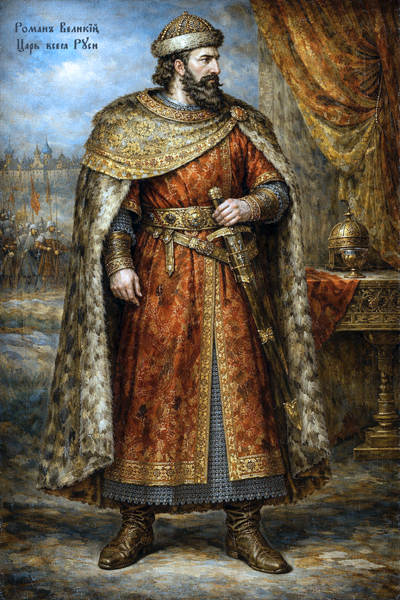 Roman the
Great, Tsar and
Autocrat of
All Rus'
Roman the
Great, Tsar and
Autocrat of
All Rus'
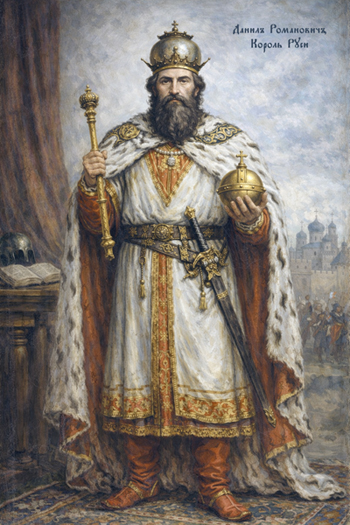 Danilo, King of Russia
Prior to that, the territory of Galicia was ruled by Andrew II, King of Hungary and Croatia as the King of Galicia. The Kingdom of Hungary also later included territories that had been part of the Kingdom of Russia.
 Andrew
II, King of Hungary and Croatia
Andrew
II, King of Hungary and Croatia
Prince and King of
Galicia
The kingdom was one of the most important of the states that emerged out of the collapse of the original Old Russian State, which resulted from the invasion of the Golden Horde. The kingdom, like the eventual resulting Russian Empire, was a descendant of the Roman Empire. The historic capital of the Kingdom is Lvov. Today the spiritual and cultural center is Moscow.*
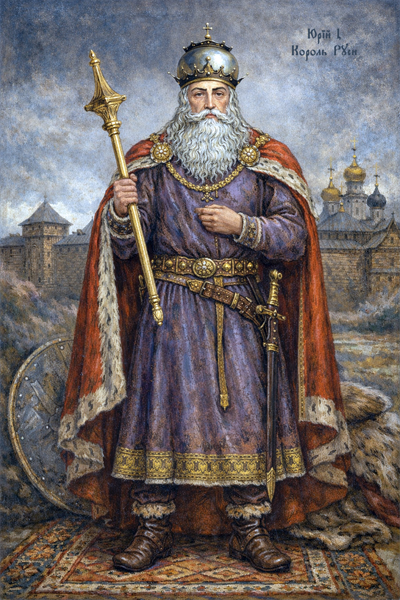 Yuri I, King of Russia
 Pope Innocent IV
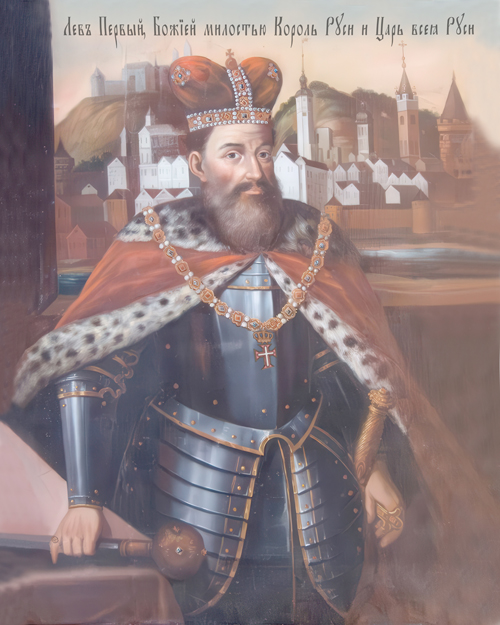 Lev I, King of Russia
 Lev II, King of Russia
Evolution and Developments
As a functioning state, it existed from 1199 to 1349 and was continually ruled by the Romanovich dynasty (a branch of the Ryurikovich (Rurikid) Dynasty that ruled Russia from the beginning of Old Russian State in 882 AD through the Russian Empire in 1584) during that time. After it was conquered by the Polish Kingdom, it ceased to exist as a functioning state. The title was not claimed by the Polish King, and therefore reverted to the Pontifical Roman State that established it. Thus the title of King of Russia and Tsar of All Rus' remains, along with its appended titles, as part of the patrimony of the Prince-Bishop of Rome-Ruthenia and His Holiness's principal eastern title (as Grand Duke of Ruthenia). The appended titles are Prince of Galicia-Volhynia, Vladimir, Novgorod, Peremyshl, and Belz. The Prince-Bishop of Rome-Ruthenia is 266th in succession from St. Peter the Apostle as Prince of the Romans, 74th Grand Duke of Ruthenia, 142nd in Gallican-Antioch succession from St. Peter, 169th in Greco-Russian succession from St. Andrew the First-Called, and 116th in Syrian-Antioch succession from St. Thomas the Apostle.


 Flag
of
the Pontifical Kingdom of Ruthenia,
Flag
of
the Pontifical Kingdom of Ruthenia,
derived from the pan-slavic colours
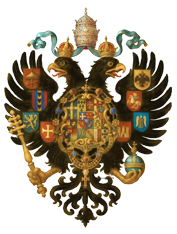
 State coat
of arms of the Pontifical Kingdom of Ruthenia
State coat
of arms of the Pontifical Kingdom of Ruthenia
The territory of the kingdom was eventually part of the Russian Empire and now is predominantly in modern-day Belarus and the Ukrainian lands. The territory of its appended title of the Principality of Novgorod comprised much of northwestern and west-central Russia. Peremyshl and Belz are located in modern-day Poland, and along with Vladimir and Galicia-Volhynia were all located within the principal territory of the Ruthenian Kingdom. The territory maintained a long history of both latin rite and eastern rite Christianity.
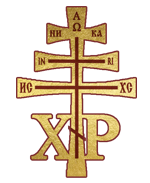 The Roman-Ruthenian
Cross, as used by the United Roman-Ruthenian Church
The Roman-Ruthenian
Cross, as used by the United Roman-Ruthenian Church
Along with Novgorod, it was one of the three most important powers to emerge from the collapse of Old Russian State. The main language was Old East Slavic, the predecessor of the modern languages of Russian, Belorussian, and Ukrainian. The official religion was Eastern Orthodoxy, though the Latin rite was also historically affiliated with the territory.
Ecclesiastical Leadership of the Kingdom of Ruthenia
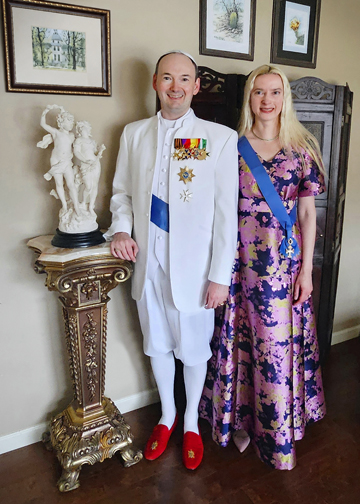
 His Apostolic Highness the Most Holy Pope Radislav I Romanovich, Prince-Bishop of
Rome-Ruthenia
His Apostolic Highness the Most Holy Pope Radislav I Romanovich, Prince-Bishop of
Rome-Ruthenia
Его Апостольское Высочество Святейший Папа Радислав I Романович,
Князь-Епископ
Рима-Руси
Её Апостольское Высочество Анна Александровна, Апостольская Княгиня Рима-Руси
Dynastic House of Johnson-Roma-Rus'
Pontifical Imperial State of Rome-Ruthenia
Pontifical and Imperial Orders of Chivalry
* N.b. The modern Kingdom of Ruthenia is an ecclesiastical and dynastic institution whose work advances historical, spiritual, cultural, and humanitarian purposes throughout its international community.